The Kabuki Handbook by Aubrey S. Halford & Giovanna M. Halford
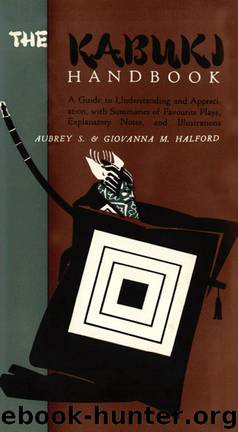
Author:Aubrey S. Halford & Giovanna M. Halford [Halford, Aubrey S.]
Language: eng
Format: mobi
ISBN: 9781462904549
Publisher: Tuttle Publishing
Published: 1989-12-15T05:00:00+00:00
OMI GENJI SENJIN YAKATA (Moritsuna's Camp), commonly called Moritsuna Jinya. Jidaimono, associated with the Taiko Cycle (see page 467).—Written for the puppets in 1769 by Chikamatsu Hanji. Only one act, Act VIII, survives out of a long play. It was adapted for the Kabuki within a few years of its first production and has now become essentially an actor's vehicle, the role of Moritsuna being considered one of the finest in Kabuki. The play concerns the siege of Osaka Castle (here called Sakamoto Castle) and the final defeat of Toyotomi Hideyori.
Act VIII consists of a subplot about two brothers and can therefore stand alone. Sasaki Moritsuna and Sasaki Takatsuna (in real life Sanada Nobuyori and Sanado Yukimura) are generals on the opposing sides. Takatsuna, the more able and daring of the two, is fighting on the losing side, that of Minamoto Yoriie (Toyotomi Hideyori). He plans a desperate stratagem to try to retrieve the position. He knows that his reputation as a commander stands high and he believes that, if the enemy think him dead, they may well relax their stranglehold.
The character of Takatsuna, who never appears on the stage, dominates the whole play. He is a man of great ruthlessness and brilliance, with the power of holding the devotion of lesser men. His little son is prepared to die for him. His brother's love for him is the theme of the play. He can read Moritsuna like a book and it is because of this that his stratagem succeeds. Takatsuna's personal magnetism makes some sort of sense out of a series of incredible events.
Moritsuna's character, on the other hand, has an almost feminine streak in it. When he tries to interpret his brother's motives, all he can imagine is what he himself would feel and do in like circumstances. Takatsuna knows this and counts on it. It is because of this "partial" outlook that Moritsuna is the less able of the two. Personal feelings obscure his judgment, not only in the final scene, but at the beginning of the play when he believes his brother may be making a desperate attempt to rescue the boy, Koshiro. This is what he would undoubtedly have done himself. Had he really understood his brother's nature, he would have known that such a surrender to emotion on Takatsuna's part was impossible.
Act VIII
Sasaki Moritsuna's camp near Lake Biwa. Moritsuna's crest is prominently displayed on the walls of his headquarters.
In a short scene, now never played, Moritsuna returns victorious from battle accompanied by his little son Kosa-buro and his nephew Koshiro, whom Kosaburo has captured. They are received by Moritsuna's wife Hayase and his mother Bimyo. Moritsuna wished to kill Koshiro on the battlefield to spare him the indignity of capture, but his commander-in-chief Hojo Tokimasa (Tokugawa Ieyasu) ordered the boy's life to be spared. Moritsuna commits Koshiro to the charge of Bimyo and retires to remove the traces of battle.
(Here the act begins.) Word comes that Wada Hide-mori, a commander under Takatsuna, has arrived asking for a parley.
Download
This site does not store any files on its server. We only index and link to content provided by other sites. Please contact the content providers to delete copyright contents if any and email us, we'll remove relevant links or contents immediately.
The Great Music City by Andrea Baker(33663)
Aircraft Design of WWII: A Sketchbook by Lockheed Aircraft Corporation(32384)
Call Me by Your Name by André Aciman(20733)
The Secret History by Donna Tartt(19473)
The Art of Boudoir Photography: How to Create Stunning Photographs of Women by Christa Meola(18760)
Shoot Sexy by Ryan Armbrust(17853)
Plagued by Fire by Paul Hendrickson(17541)
Portrait Mastery in Black & White: Learn the Signature Style of a Legendary Photographer by Tim Kelly(17107)
Adobe Camera Raw For Digital Photographers Only by Rob Sheppard(17094)
Photographically Speaking: A Deeper Look at Creating Stronger Images (Eva Spring's Library) by David duChemin(16800)
Ready Player One by Cline Ernest(15146)
Pimp by Iceberg Slim(14800)
Bombshells: Glamour Girls of a Lifetime by Sullivan Steve(14220)
The Goal (Off-Campus #4) by Elle Kennedy(13966)
Art Nude Photography Explained: How to Photograph and Understand Great Art Nude Images by Simon Walden(13147)
Kathy Andrews Collection by Kathy Andrews(12093)
The Priory of the Orange Tree by Samantha Shannon(9364)
The remains of the day by Kazuo Ishiguro(9225)
Thirteen Reasons Why by Jay Asher(9122)
